ActivePure Journal
11 Air Purification Technologies Explained
Air purification is not one single technology. This guide explains the main passive and proactive air purification methods, including filters, carbon, UV, ionization, PCO and ActivePure advanced photocatalysis, in simple language.
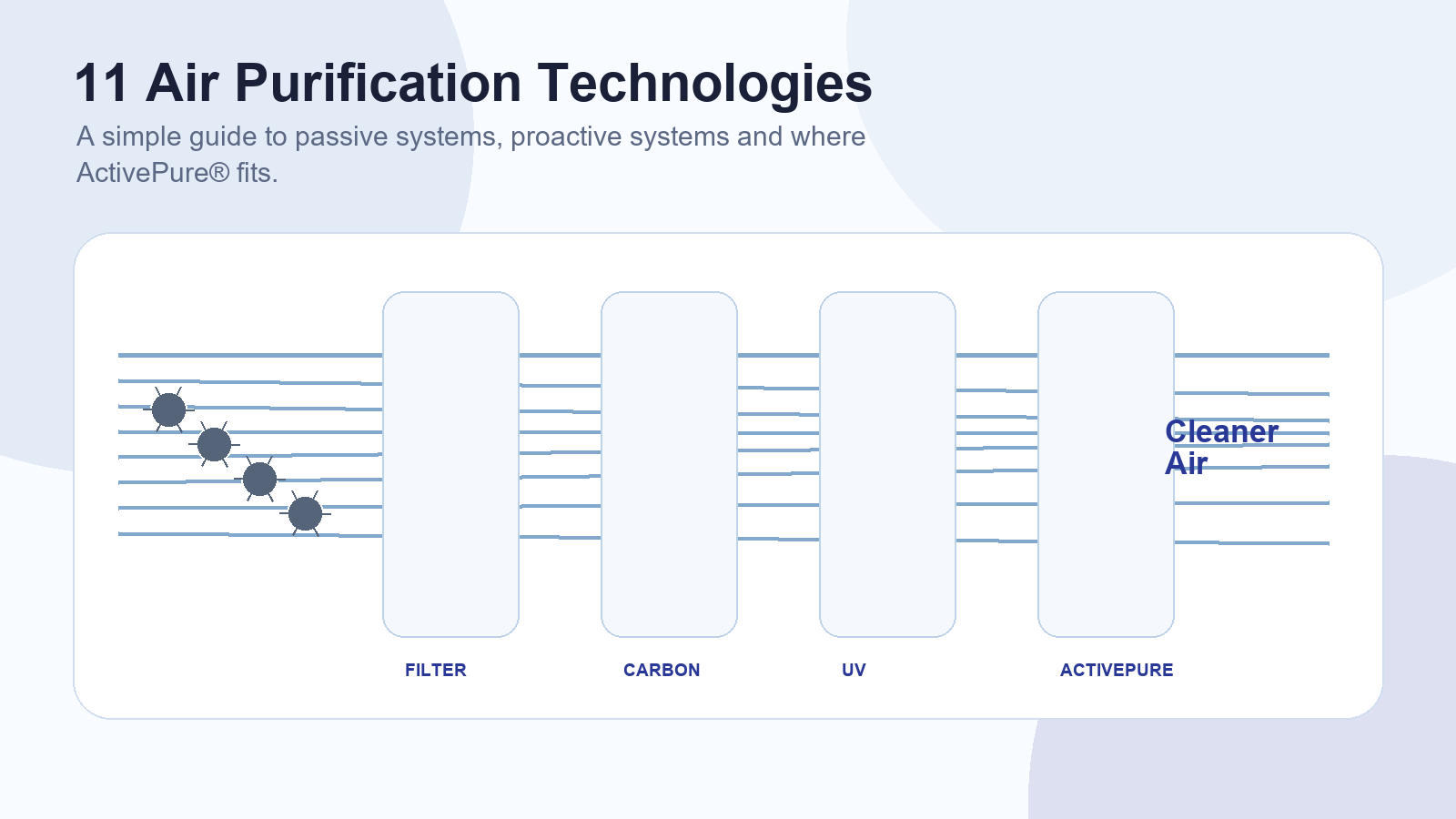
Indoor air can contain many different types of contaminants, including dust, pollen, odors, smoke particles, volatile organic compounds and microorganisms. Because these contaminants behave differently, air purification is not solved by one method alone.
Some technologies are passive. They work only when air passes through a filter, chamber or duct. Other technologies are proactive. They are designed to move treatment into the occupied space and support purification in the air and on exposed surfaces.
This article explains 11 common air purification technologies in a simple way, so readers can understand what each method does, where it helps and where it has limits.
Why there are many types of air purification
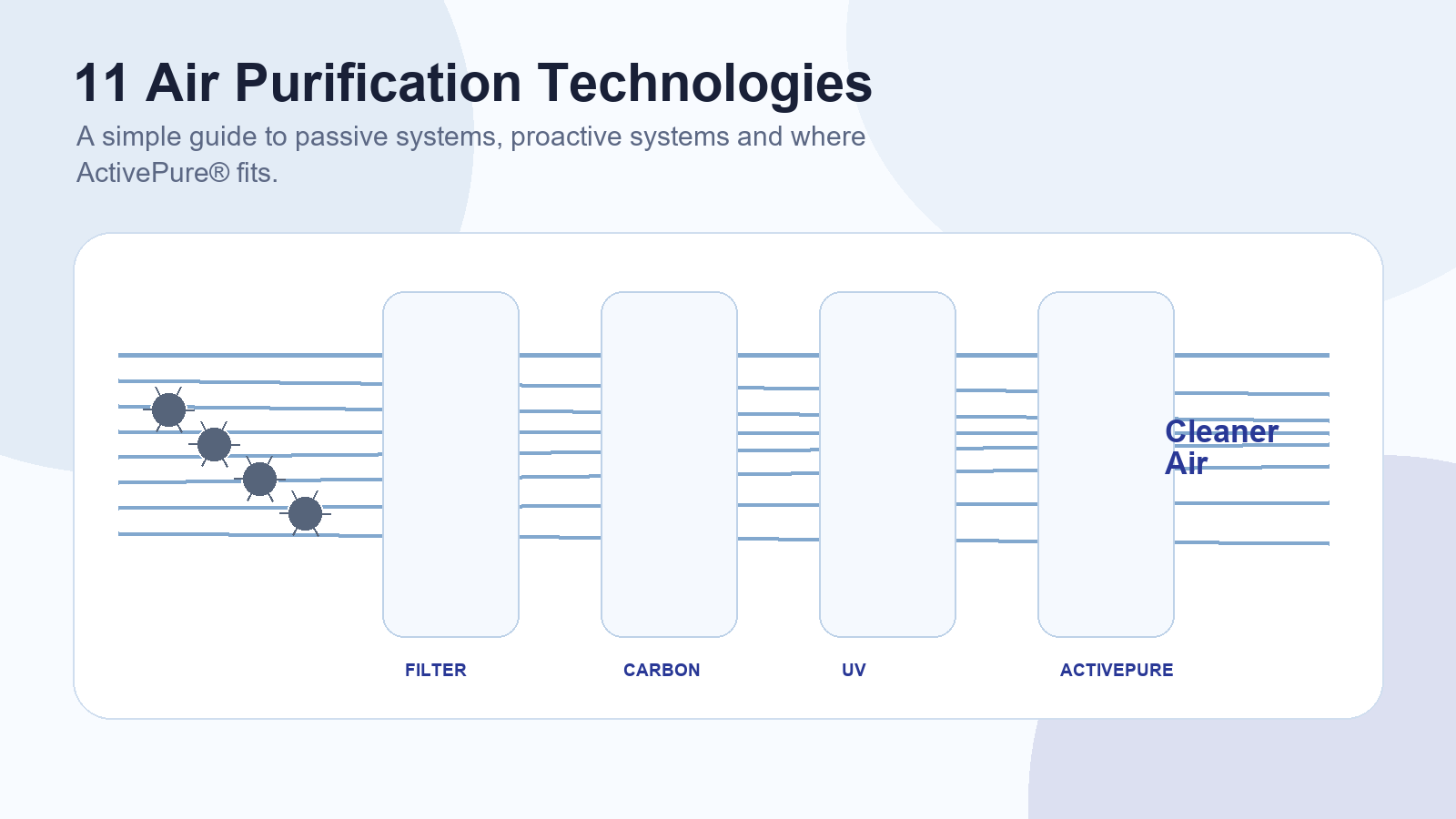
Air purification technologies are designed for different types of indoor air problems. A filter can capture many particles, but it may not handle odors or gases well. Carbon can help with smells and some VOCs, but it does not work like a particle filter. UV light can support microbial control, but only where the light reaches.
This is why it is useful to understand the main categories of air purification instead of looking at every system as the same thing. The two biggest categories are passive and proactive technologies.
Passive technologies wait for air to reach them. Proactive technologies are designed to move into the occupied space and support treatment beyond the device itself.
Passive vs proactive purification
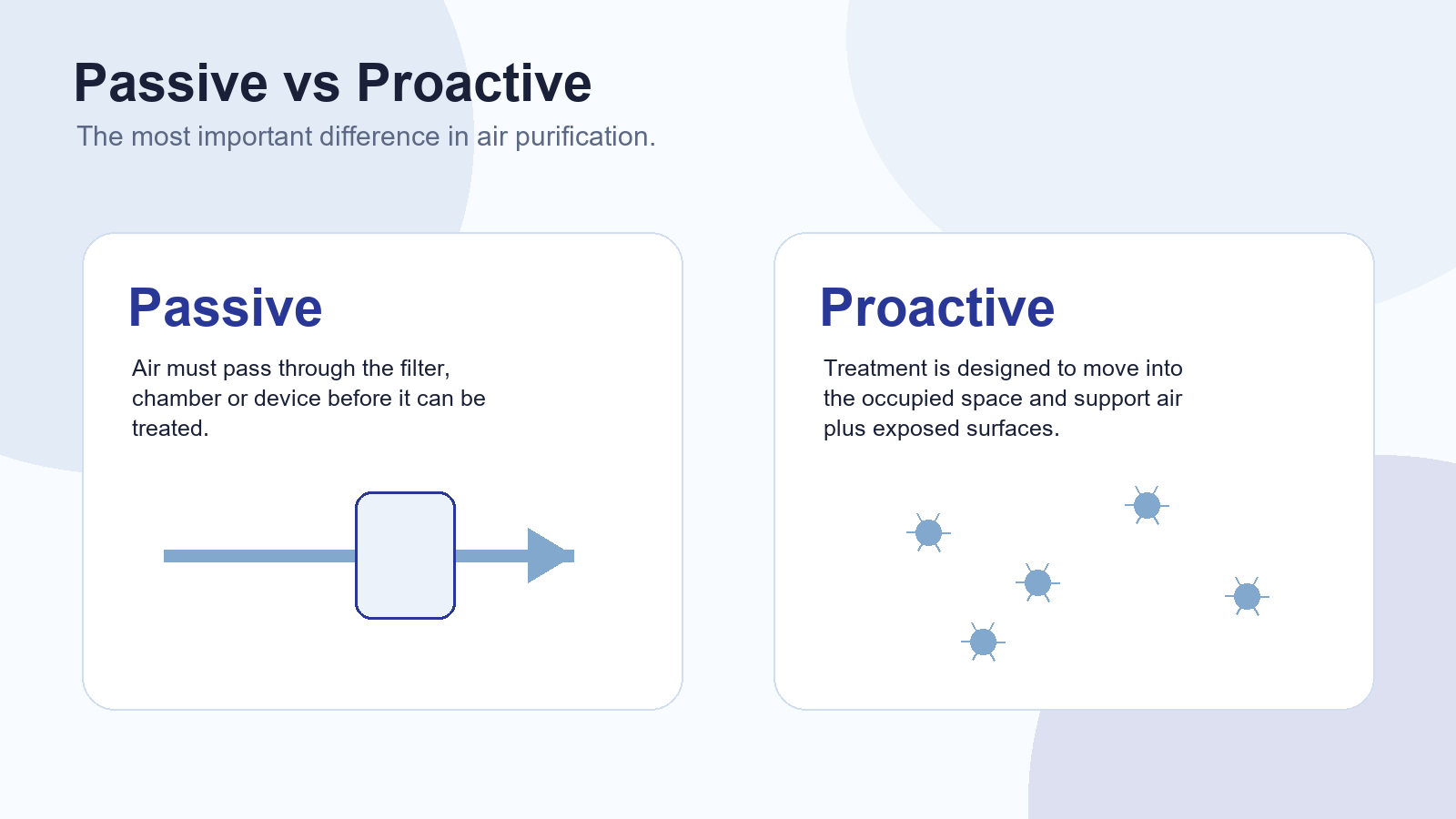
Passive purification works when air is pulled into a unit, filter, chamber or duct. The technology treats the air only when that air reaches the system. This includes filters, carbon media, UV chambers, electrostatic systems and heat based systems.
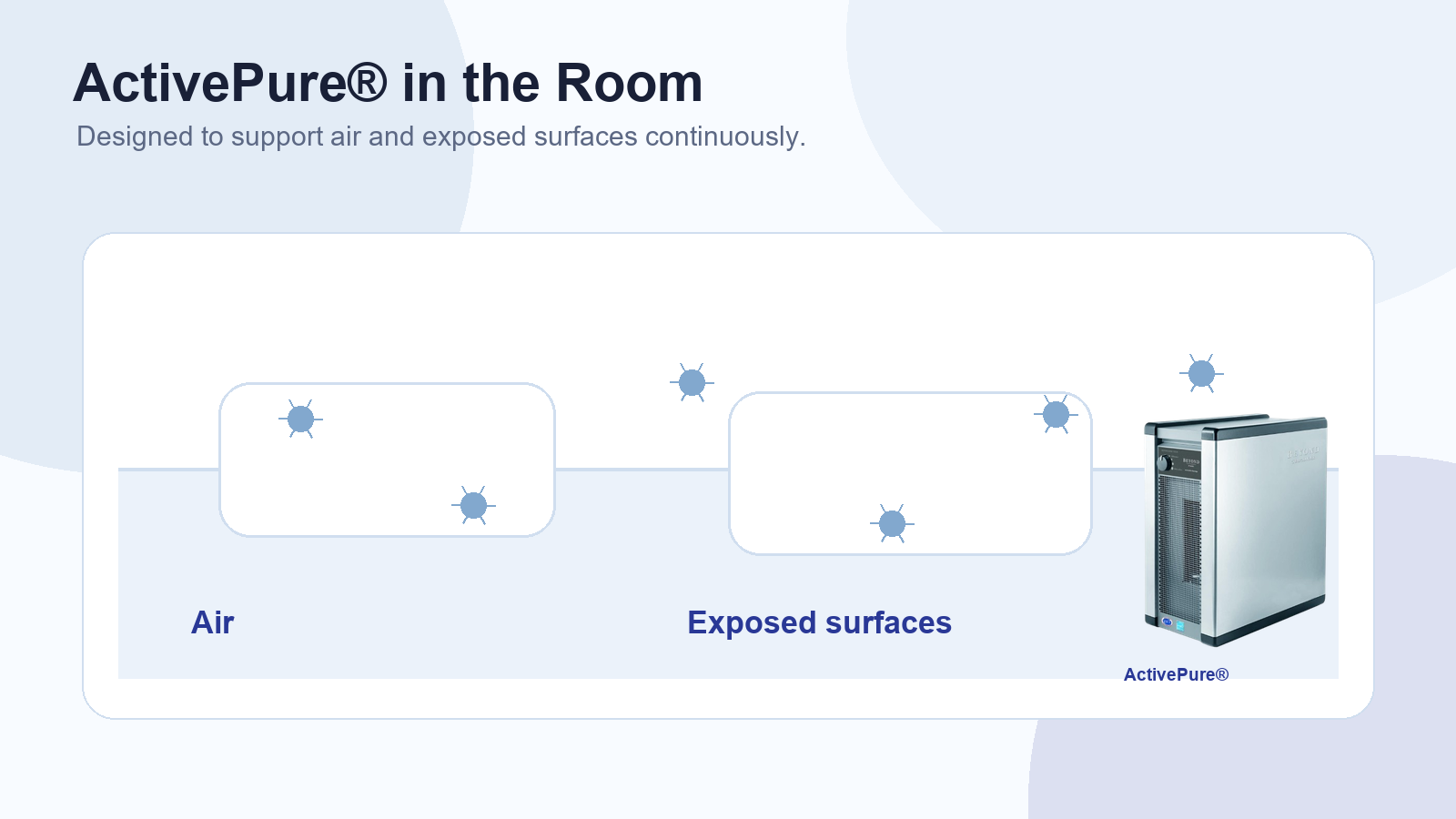
Proactive purification works differently. It is designed to support purification throughout the occupied room, not only inside the machine. ActivePure is an example of a proactive purification technology because it supports air and exposed surfaces while the system is operating.
Both approaches can be useful. The strongest air quality strategy often combines particle capture with proactive purification support.
1. Fibrous filter media
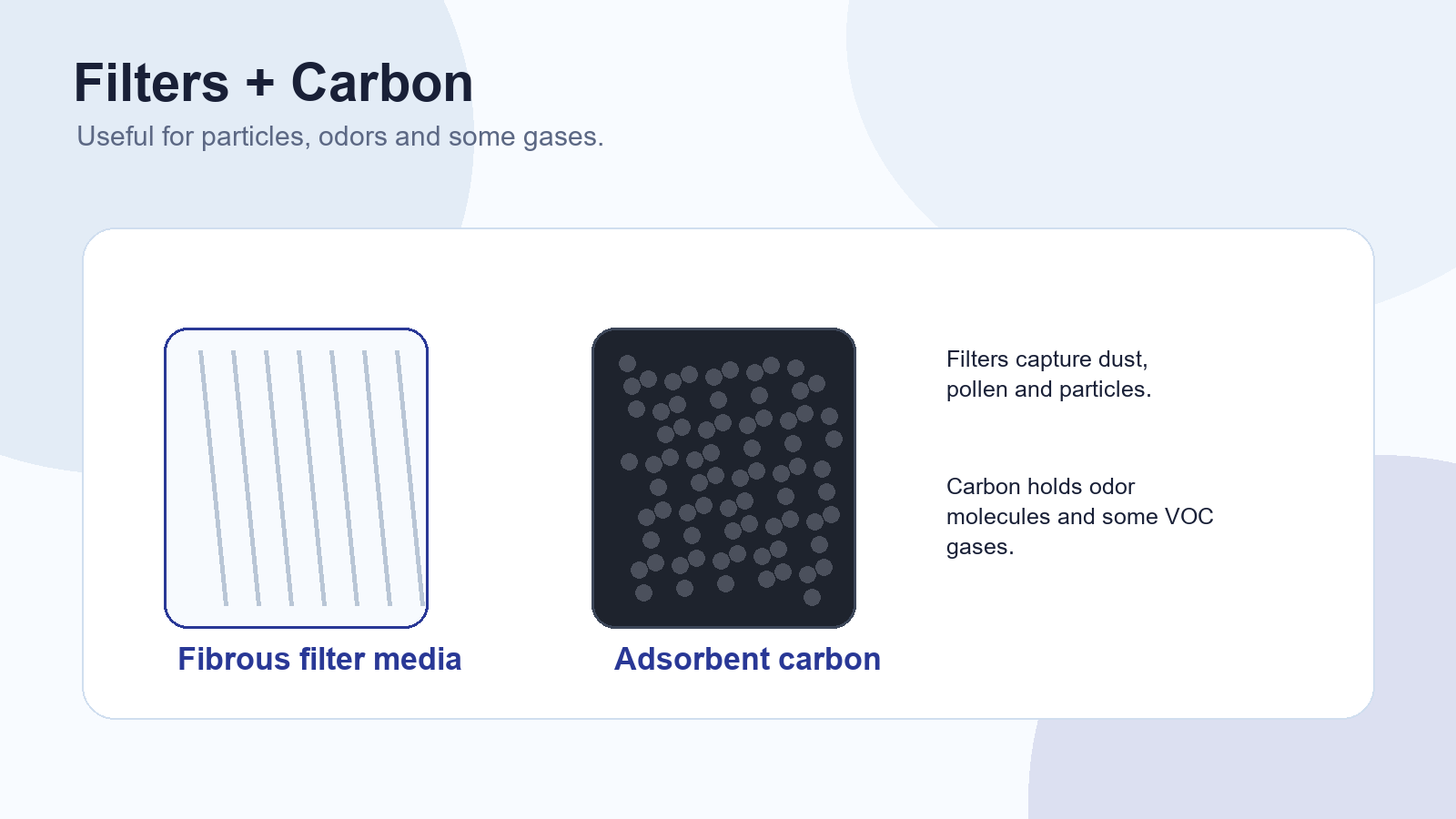
Fibrous filter media is the most familiar air filtration method. HEPA style filters and electret filters are examples of this type of technology.
Air is pulled through layers of fine fibers. Larger particles are blocked, while smaller particles can stick to the fibers as they move through the filter. This makes fibrous filters useful for dust, pollen, lint, allergens and many airborne particles.
The limitation is that the air must pass through the filter first. If the air does not reach the filter, the filter cannot treat it. Filters also need replacement because captured particles build up over time.
2. Electrostatic precipitation
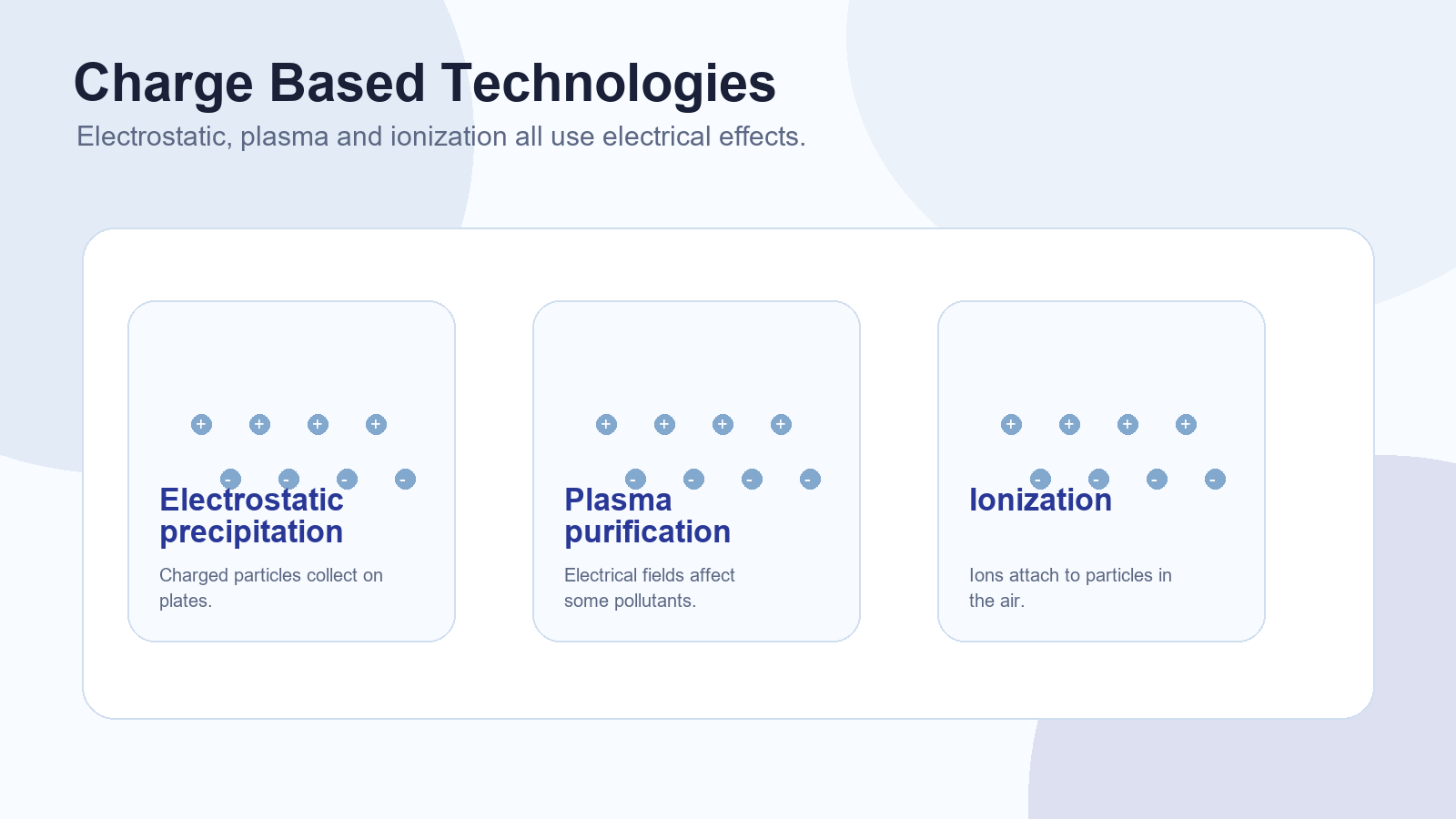
Electrostatic precipitation uses electrical charge to collect particles from moving air. Particles are charged inside the unit and then attracted to collection plates with the opposite charge.
This method can be useful for fine particles, smoke particles and some industrial dust applications. The benefit is that particles can be removed without using a traditional disposable filter in the same way.
The limitation is maintenance. The plates need cleaning, and the technology is mainly focused on particles. It does not solve every indoor air quality problem by itself.
3. Plasma purification
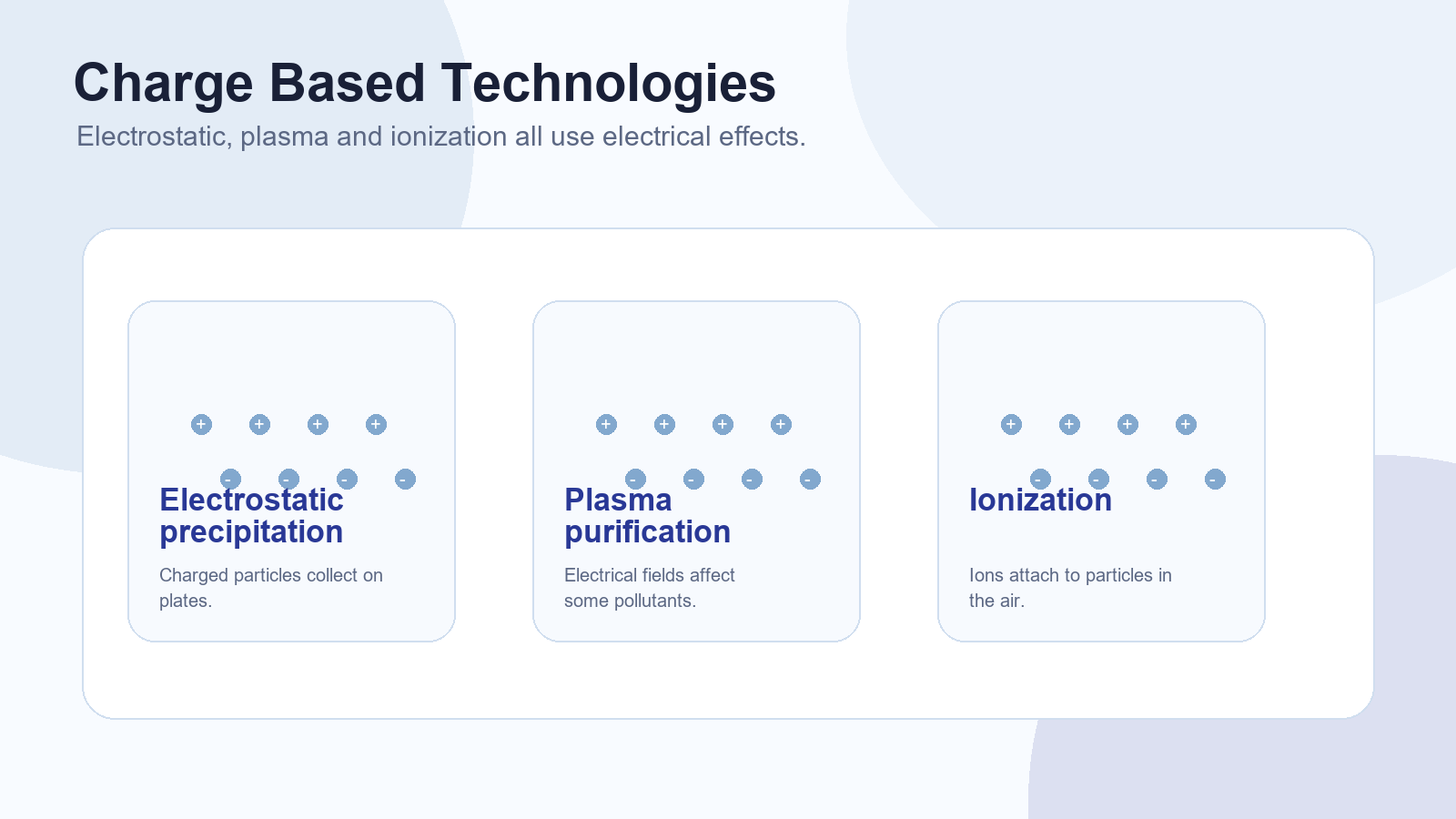
Plasma purification uses an electrical field to affect certain contaminants in the air stream. As air passes through the plasma field, electrical energy can interact with some pollutants and chemical bonds.
This technology is used in some advanced air treatment applications. It may help with certain gases or pollutants depending on the design of the system.
The important point is that performance depends heavily on product design, airflow, testing and safety controls. Not all plasma systems are the same.
4. Adsorbent media

Adsorbent media is used to hold gases and odors. Activated carbon is the most common example. It has a very large surface area, which allows odor molecules and some VOC gases to stick to the media as air passes through.
This makes carbon useful for smells, smoke related odors and some chemical vapors. It is often used together with particle filtration.
The limitation is that carbon becomes saturated. Once it is full, it cannot keep holding new molecules effectively. This is why carbon media must be replaced at the correct time.
5. Passive UVGI
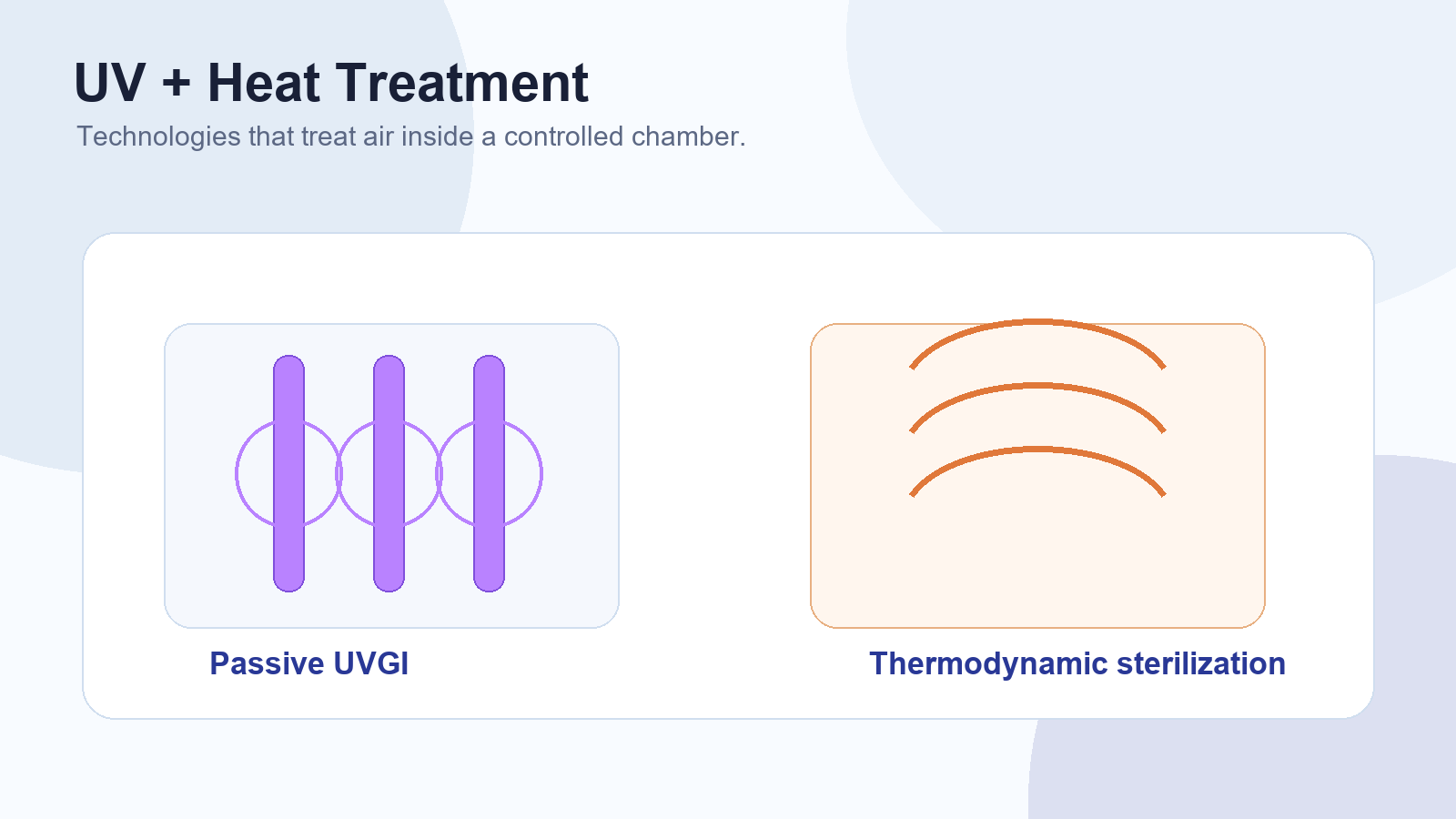
UVGI means ultraviolet germicidal irradiation. In passive UV systems, the UV light is placed inside a device, chamber or HVAC duct. Air passes near the UV light, and microorganisms receive ultraviolet exposure inside the treatment area.
UVGI can support microbial control when exposure time, distance and UV strength are correct.
The limitation is that it only treats what passes through the UV zone. Shadows, dust on the lamp, poor maintenance and fast airflow can reduce results.
6. Thermodynamic sterilization
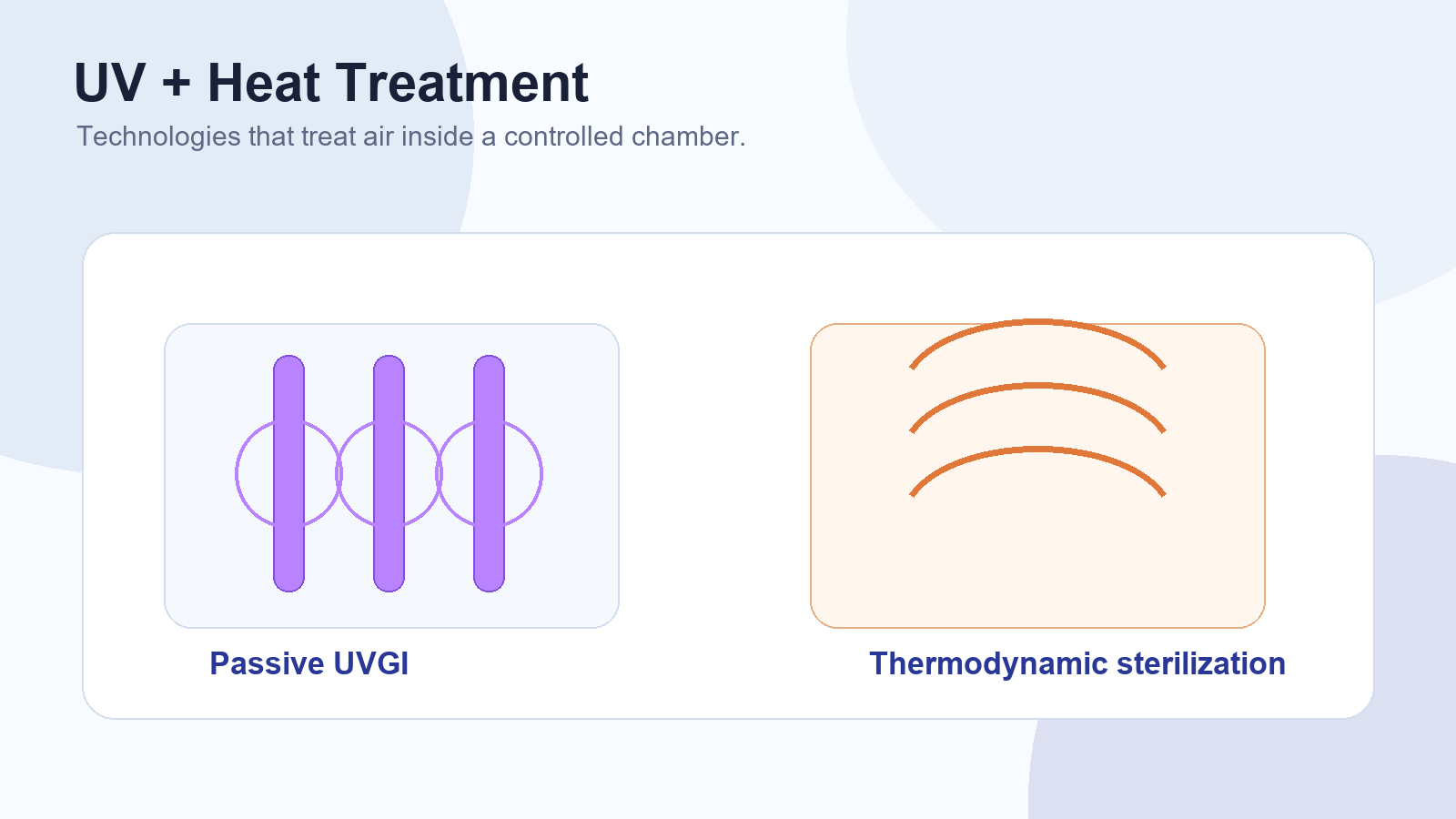
Thermodynamic sterilization uses heat to treat air inside an internal chamber. Air passes through a heated section where high temperature is used to treat biological contaminants.
This method can be quiet and can support biological treatment inside the device.
The limitation is that it is still passive. Air must pass through the device before treatment happens. It also does not work like a particle filter or odor control media.
7. Whole room UV
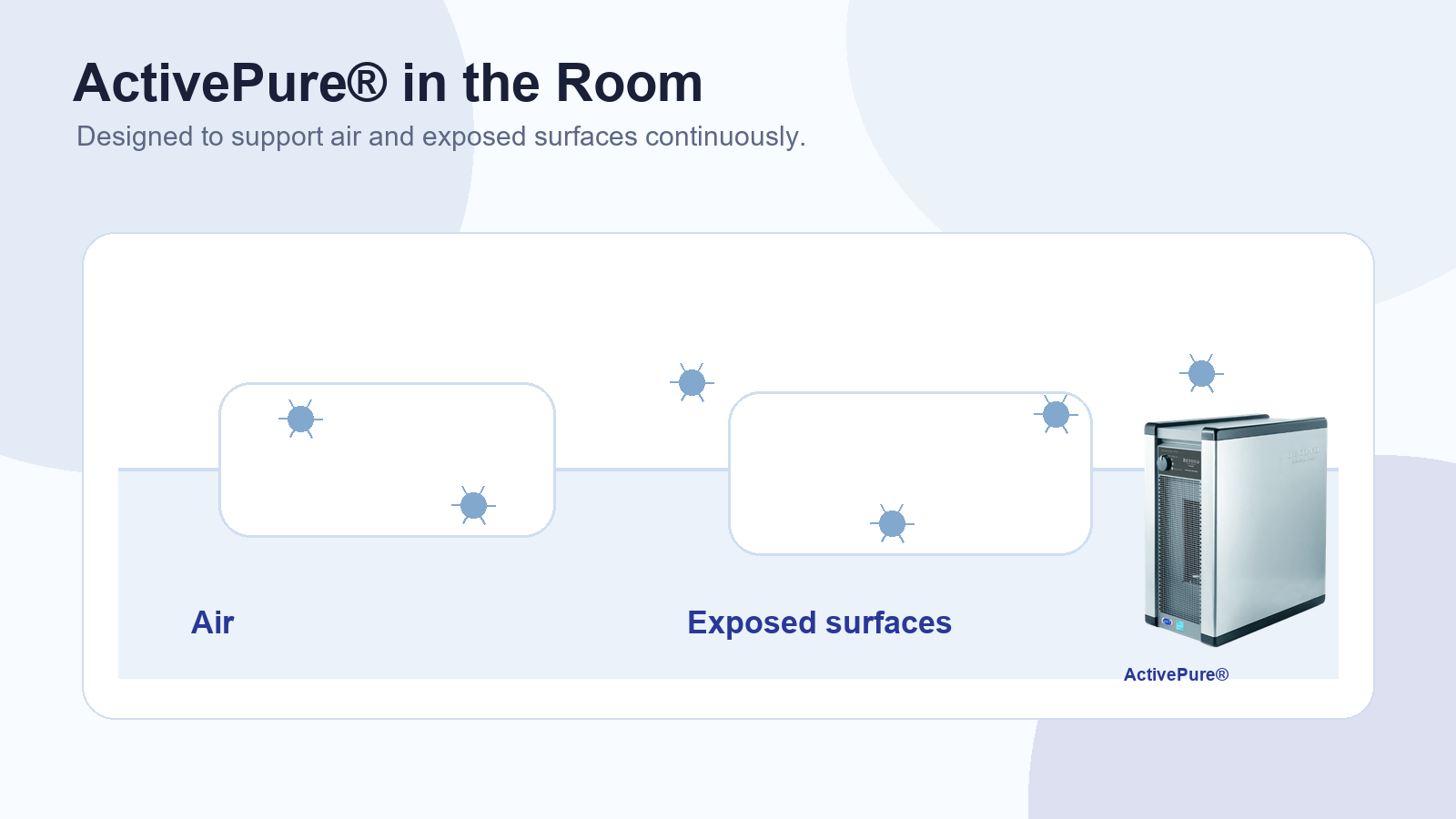
Whole room UV uses ultraviolet light across a room, usually after people leave the space. The light is directed into the room so exposed air and visible surfaces receive UV exposure.
This can be useful for healthcare style room disinfection and certain controlled environments.
The limitation is that whole room UV is normally used in unoccupied spaces. Shaded areas may not receive proper exposure, and the process must be controlled carefully.
8. Intentional ozone
Intentional ozone systems release ozone into a controlled space. Ozone reacts strongly with some odors and pollutants.
This can help with certain odor treatment applications in unoccupied spaces.
The limitation is safety. Ozone can be harmful to breathe and should not be used casually in occupied rooms. Any ozone based system must be controlled carefully and used only as directed.
9. Ionization
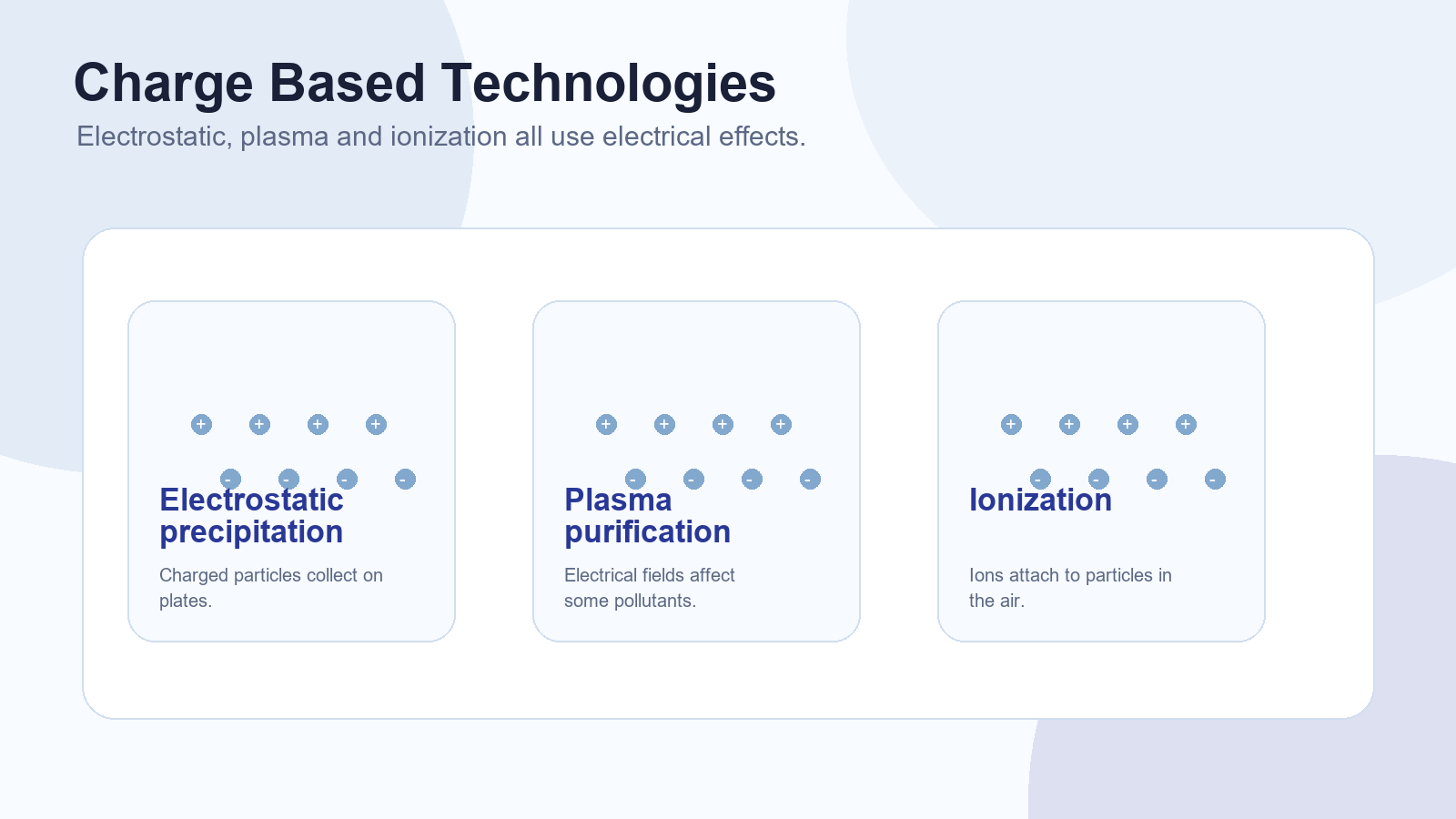
Ionization releases charged particles that interact with airborne particles. These ions can attach to particles, making them clump together, become heavier or settle on surfaces.
Ionization can support some particle reduction and may operate quietly.
The limitation is that particles may settle onto surfaces instead of being fully removed from the room. Some ionizers may also create ozone depending on design.
10. Photocatalytic oxidation
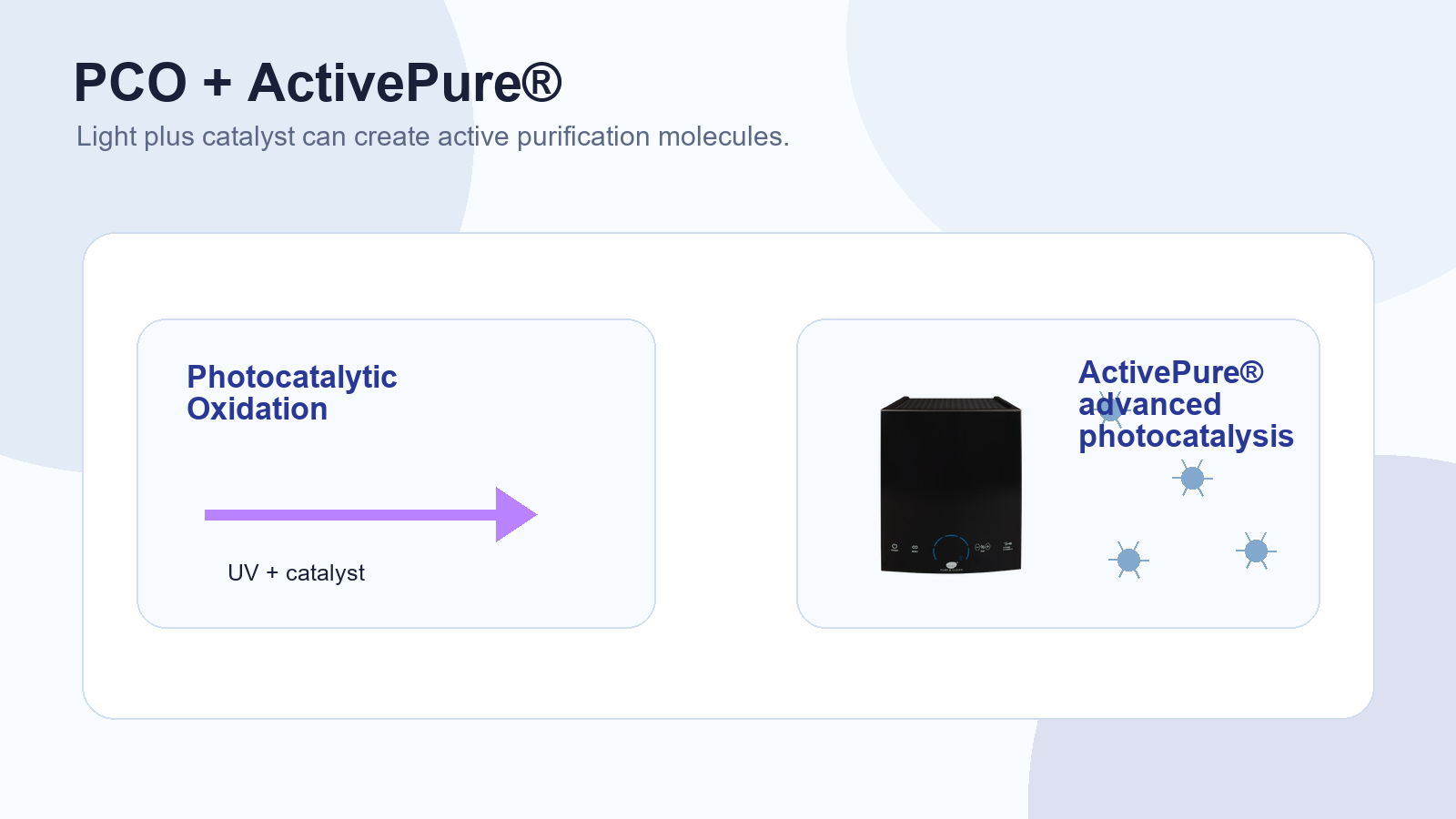
Photocatalytic oxidation, often called PCO, uses light and a catalyst to create reactive molecules. These molecules can interact with microbes and some gases.
PCO can be useful when the system is properly designed and tested.
The limitation is that older or poorly designed systems may create unwanted byproducts. PCO also does not capture dust by itself, so filtration can still be useful.
11. ActivePure advanced photocatalysis
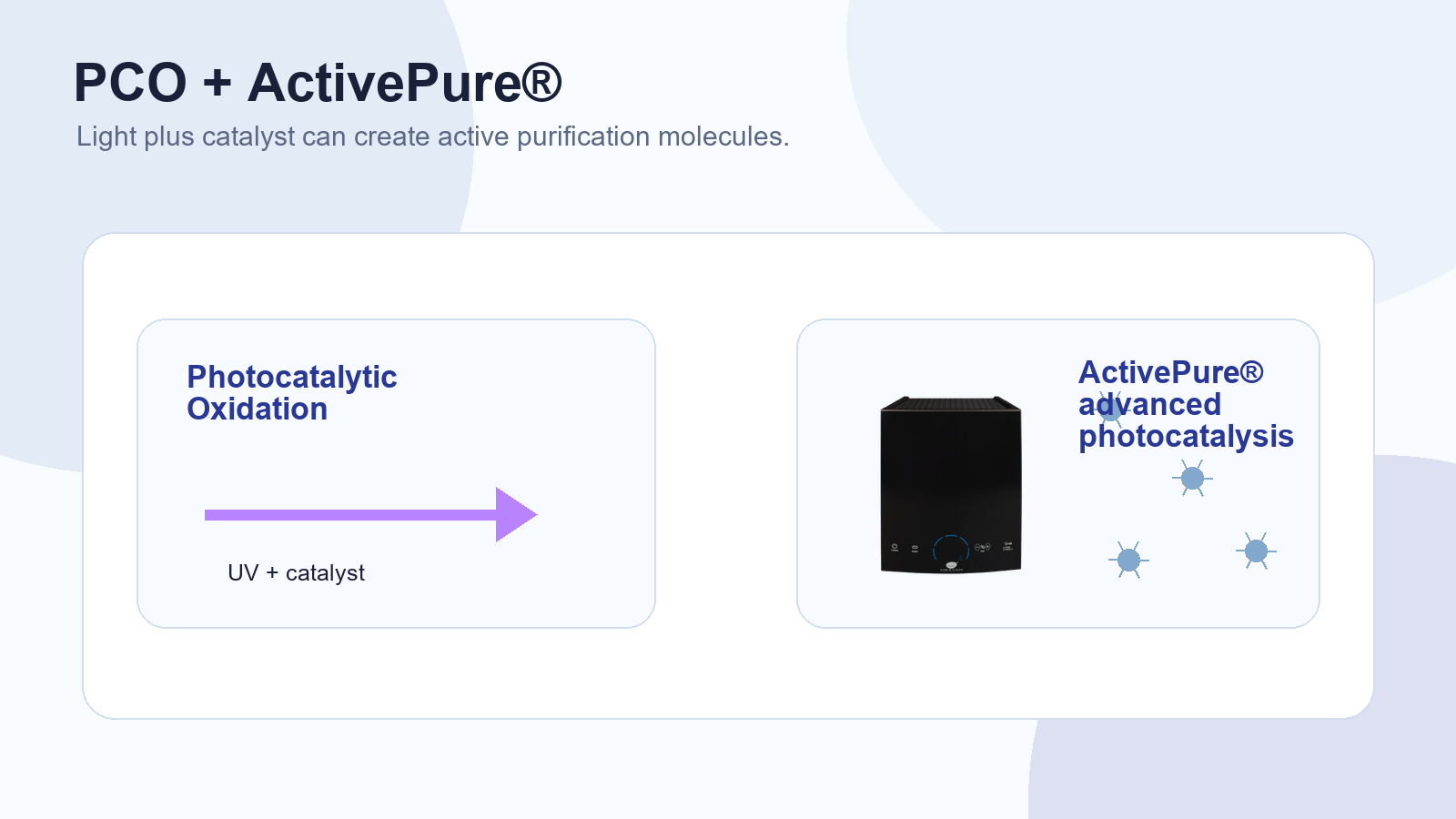
ActivePure advanced photocatalysis is a proactive purification technology. It uses a specialized light and catalyst process to create active molecules that move through the occupied space.
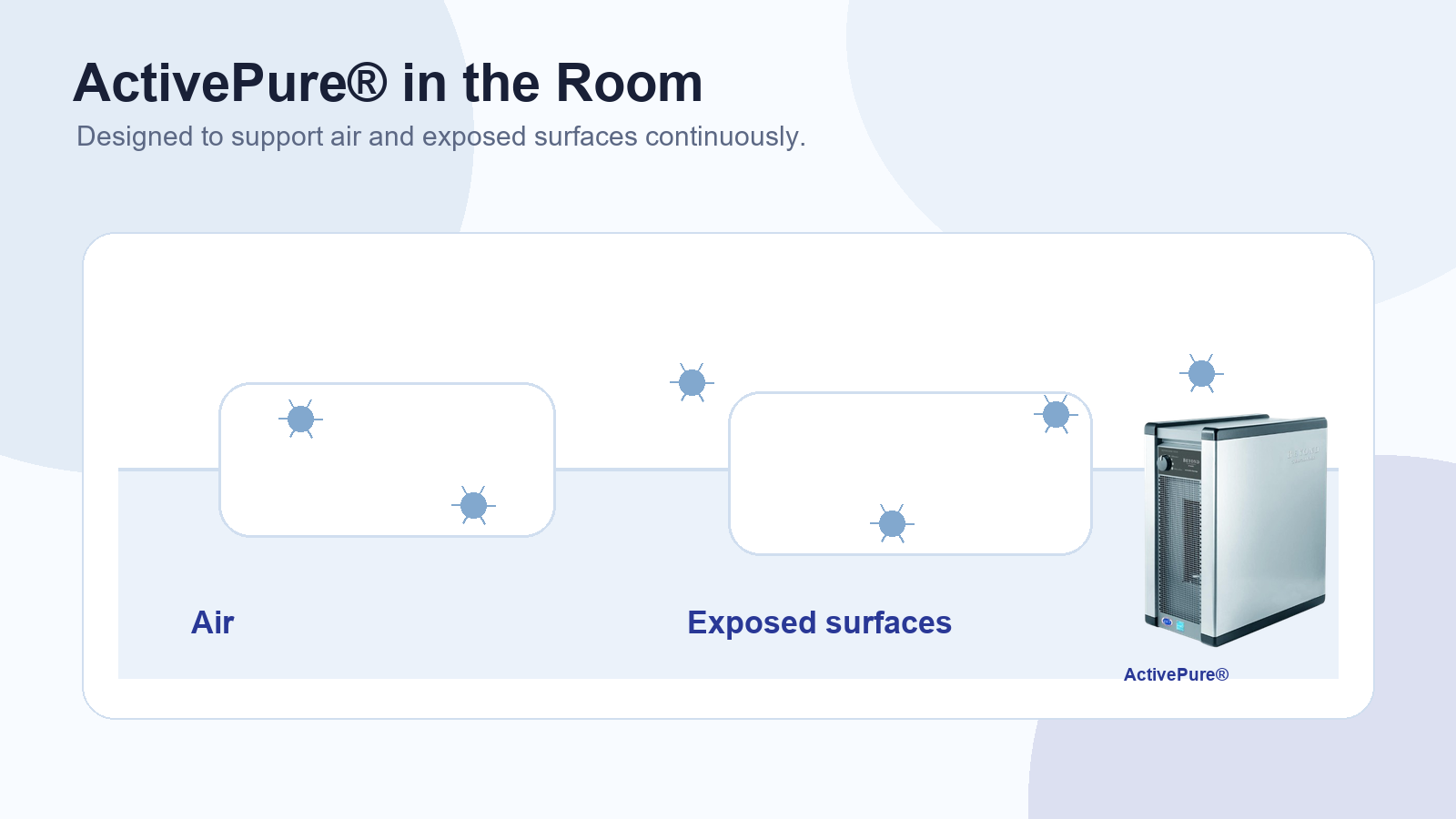
The key difference is that ActivePure is designed to support purification in the air and on exposed surfaces, not only inside the machine. This makes it different from a simple filter that waits for air to pass through it.
ActivePure should still be correctly sized for the space and used with proper airflow. Filtration remains useful where particle capture is needed, but ActivePure adds a proactive layer of continuous purification support.
Final thoughts
No single air purification technology solves every indoor air quality concern. Filters help capture particles. Carbon helps with odors and some gases. UV and heat based systems treat air inside controlled zones. Ionization and PCO can support additional treatment depending on system design.
ActivePure stands out because it is designed as a proactive technology. It supports continuous purification in the occupied space, helping with both air and exposed surfaces.
For homes, offices, healthcare spaces, schools and shared indoor environments, the strongest approach is to understand the role of each technology and choose a system that fits the space, airflow and purpose.
ActivePure UAE
Find the right purification solution for your space.
Explore our products or speak with the ActivePure UAE team.
Helpful Answers
Frequently Asked Questions
Passive purification treats air only when it passes through a device, filter or chamber. Proactive purification is designed to move treatment into the occupied space and support the air and exposed surfaces.
No. HEPA style filters are passive particle capture systems. ActivePure is a proactive purification technology designed to support purification beyond the device.
Carbon is mainly used for odors and some gases. It is not a replacement for particle filtration.
Passive UVGI normally treats air inside a device or duct. Whole room UV is different and is usually used in unoccupied spaces.
Many air purifiers wait for air to pass through the machine. ActivePure is designed to support purification in the occupied space, including air and exposed surfaces.
Yes, filtration can still be useful for capturing particles. ActivePure adds proactive purification support, so the two approaches can work together.