
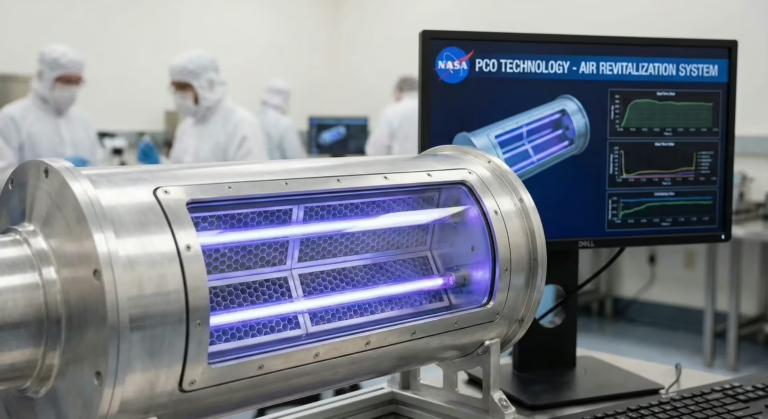
Photocatalytic Oxidation began as a NASA solution to a challenge faced in space: keeping the air inside sealed spacecraft clean. During research on plant growth in orbit, NASA discovered that this process could break down unwanted gases and reduce microscopic contaminants without relying on airflow. This breakthrough later inspired ActivePure, a technology that adapts NASA’s science for everyday indoor environments. By producing safe, effective cleaning molecules, ActivePure continuously treats both the air we breathe and the surfaces we touch. In this article, we explore NASA’s original discovery, ActivePure’s improvements, and the scientific evidence behind its performance.
Understanding NASA’s Discovery of Photocatalytic Oxidation
NASA’s interest in new air-cleaning methods began when researchers realized that the closed environment of a spacecraft posed unique challenges not found on Earth.
The Air Problems NASA Faced in Space
While studying plant growth in space, NASA found that ethylene gas released by plants quickly built up inside the sealed spacecraft. On Earth, this gas spreads out, but in space, it stays trapped and harms the plants. Because healthy plant growth was necessary for long missions, NASA needed a way to control this problem.
Why Traditional Filtration Could Not Solve the Problem
Typical air filters could not solve NASA’s problem because they only work when air moves through them. In a spacecraft, the air barely circulates, so gases like ethylene remain in the environment without ever passing through a filter. Even advanced systems could not remove contaminants that were floating in place. NASA needed a method to continuously clean the air, even when airflow was low.
NASA Identified Photocatalytic Oxidation as a Solution
NASA tested many ideas before turning to photocatalytic Oxidation. During their experiments, they noticed that certain materials reacted in a useful way when exposed to ultraviolet light. Titanium dioxide was one of those materials, so they focused on it to see what it could do.
When UV light strikes the surface of titanium dioxide, it triggers a reaction that produces highly reactive molecules called hydroxyl radicals. These molecules are essential because they can break down gases and organic pollutants by attaching to them and splitting them apart. This is different from a regular air filter. Instead of trapping contaminants, the process changes them into simple, harmless substances. For NASA, this was promising because it worked even when the air inside the spacecraft was still.
The more NASA tested this reaction, the more effective it appeared to be. It quickly lowered the ethylene levels that were harming the plants, which was the primary goal. But researchers also saw that the same reaction could reduce other organic compounds and even affect tiny biological particles. This showed them that photocatalytic Oxidation could keep the air cleaner in a sealed environment and solve a problem that traditional filtration systems could not handle.
How NASA’s Technology Evolved Into ActivePure
NASA’s discovery of photocatalytic Oxidation provided a strong scientific foundation, but turning it into a system suitable for everyday indoor environments required additional work. Over time, researchers and engineers refined the original concept and developed the technology now known as ActivePure.
From NASA Research to Commercial Technology
After NASA demonstrated that photocatalytic Oxidation could control ethylene and reduce other organic contaminants in a closed spacecraft, the technology drew interest from organizations seeking new ways to improve indoor air quality. The idea was promising, but NASA’s setup was designed for controlled scientific environments. For it to be used more widely, the process needed to be adapted for different room sizes, airflow levels and everyday conditions.
Engineers began modifying the design to enable reliable operation outside laboratory settings. They worked on creating versions that were safe, stable and effective in homes, schools, offices and other common indoor spaces. This transition marked the first step in transforming NASA’s discovery into a practical commercial technology.
How ActivePure Improved the Original PCO Process
ActivePure was built on NASA’s original photocatalytic oxidation system by introducing several key advancements.
Improved catalyst design:
The catalyst’s material combination was modified to enable a more efficient reaction with ultraviolet light. This change helped produce a stronger and more consistent output of reactive molecules.
Enhanced UV interaction:
The system was redesigned to optimize the delivery and activation of ultraviolet light to the catalyst. This allowed the reaction to operate more effectively and improved the overall performance of the process.
Release of cleaning molecules into the environment:
Instead of keeping the reaction contained inside the device, ActivePure enables the reactive molecules to move outward into the room. This allows them to reach both the air and the surrounding surfaces.
These improvements transformed NASA’s scientific concept into a more powerful and practical purification technology that can support cleaner indoor environments across many settings.
How ActivePure Uses NASA’s Science to Clean Indoor Air
ActivePure takes the core idea behind NASA’s photocatalytic oxidation research and applies it to work in everyday indoor spaces continuously. The system produces cleaning molecules that are released into the environment, where they can react with airborne contaminants and those on surfaces.
The Cleaning Molecules ActivePure Produces
ActivePure generates several types of reactive molecules during operation. Each plays a specific role in breaking down pollutants.
- Hydroxyl radicals: Highly reactive molecules that quickly attach to and break apart organic contaminants.
- Hydrogen peroxide: Produced in small, controlled amounts that help weaken or neutralize microbes in the air.
- Superoxide ions: Charged particles that support the overall cleaning process by targeting a variety of pollutants.
Together, these molecules create a consistent cleaning effect throughout the space.
How ActivePure Technology Works Inside a Room
ActivePure technology works in a few simple steps to clean both the air and nearby surfaces.
Step 1: The device creates cleaning molecules: Inside the unit, light interacts with a special surface to produce reactive molecules. These include hydroxyl radicals, small amounts of hydrogen peroxide and superoxide ions. They are created at safe levels for use around people.
Step 2: The molecules enter the room: Once formed, they leave the device and spread into the surrounding air. They are not trapped inside the unit.
Step 3: They move with natural airflow: The molecules travel through the room with everyday air movement from fans, ventilation or regular activity. This helps them reach areas that filters usually miss, such as corners or low-airflow spots.
Step 4: They reduce airborne contaminants: As the molecules move, they come into contact with bacteria, viruses and other airborne pollutants. The oxidation process begins to break these contaminants down by damaging their structure.
Step 5: They settle on surfaces and continue working: Some molecules eventually land on surfaces like desks, handles or equipment. There, they continue the same cleaning process, helping to reduce contaminants that rest on objects rather than float in the air.
Challenges of Early PCO and How ActivePure Made It Safe
Photocatalytic Oxidation offered strong cleaning potential, but the early versions of this technology were not designed for continuous use around people. As researchers worked with different forms of PCO, they found that although the reaction was powerful, it needed more control to operate safely in everyday indoor environments.
Challenges of Early PCO Systems
Early PCO systems were helpful in breaking down contaminants, but they also came with two important limitations.
- Possible ozone production: Some early PCO setups generated small amounts of ozone during operation. Even at low levels, ozone is not suitable for indoor spaces because it can irritate the eyes, throat and respiratory system.
- Formation of unwanted byproducts: In certain situations, contaminants were not fully broken down into simple components. Instead, the reaction could create secondary compounds that were not intended and were not ideal for long-term indoor use.
These issues showed that early PCO systems needed significant improvements before they could be safely used in homes, schools or medical environments.
How ActivePure Created a Safe and Reliable Version of PCO
ActivePure redesigned the photocatalytic oxidation process so it could be used safely and effectively in real indoor spaces. Several important engineering improvements helped remove the limitations seen in earlier versions.
Redesigned reaction structure
The reaction chamber and catalyst materials were updated to keep the process more controlled and stable. This allowed the reaction to work efficiently while avoiding unwanted side effects.
Completely ozone-free operation
Through changes in the catalyst and the way light interacts with it, ActivePure eliminated ozone production entirely. This makes the technology suitable for continuous use around people.
Prevention of harmful byproducts
By optimizing the reaction steps, contaminants are fully broken down into simple and harmless components. This prevents the creation of secondary compounds during operation.
These refinements allowed ActivePure to use NASA’s scientific foundation while delivering a version of the technology that is safe for long-term indoor use.
NASA Expert Perspective on Using Active Technologies Properly
The NASA Spinoff report also includes insight from specialists who work with environmental control systems. One of them, Jay Perry, explains that active purification technologies work best when they are used as part of a complete air quality strategy.
According to Perry, active technologies should support ventilation and filtration rather than replace them. The best results appear when passive and active systems operate together. Proper engineering is essential for active technologies to deliver consistent results.
This perspective is important for understanding how ActivePure fits into a science-based approach to air quality. Instead of acting as a standalone device, ActivePure is designed to work alongside existing systems and reach contaminants that filters cannot capture on their own. This alignment with NASA’s principles shows that ActivePure is not simply a consumer product, but a technology built on engineering methods that match NASA’s own approach.
Scientific Evidence Behind ActivePure’s Effectiveness
ActivePure technology has been tested in both controlled laboratory settings and real indoor environments. These studies help demonstrate how the technology performs under different types of contaminants and everyday conditions.
University Research (Kansas State, Cincinnati)
Independent university testing has provided strong early evidence of ActivePure’s capabilities. In studies performed at Kansas State University and the University of Cincinnati, researchers tested ActivePure units against airborne bacteria, viruses and organic particles.
The results showed a significant reduction in microbial levels, including up to 90 percent of specific airborne contaminants within a short period. These controlled experiments confirmed that the technology’s oxidation process could quickly weaken or neutralize a variety of airborne microbes.
Real-World Case Studies
Several real-world tests further demonstrated the technology’s performance outside the lab.
Hotels:
In one study involving hotel rooms, ActivePure helped reduce bacteria and fungal growth on different surfaces. After several weeks of continuous use, microbial levels dropped from high initial counts to almost undetectable levels, even in areas frequently touched by guests.
Schools:
Schools that installed ActivePure devices reported noticeable reductions in illness-related absences. Some facilities also saw improvements in the cleanliness of athletic areas, which are often prone to bacterial contamination.
Sports facilities (Texas Rangers and MLB teams):
Professional sports facilities also offered a helpful test. After several Texas Rangers players dealt with repeated MRSA infections, ActivePure units were installed in their locker rooms and training areas. Testing afterward showed a significant drop in microbial contamination, leading the team to continue using the technology. Over time, many other Major League Baseball teams adopted it as well.
Hospital and Medical Environment Testing
Hospitals are difficult places to keep clean because many people move through them each day, and many patients are more sensitive to germs. Even with strict cleaning routines, it can be challenging to maintain consistently low levels of contaminants in the air and on surfaces.
In one study inside a hospital operating room, ActivePure technology was added to the environment. Within only a few days, the amount of airborne particles and bacteria dropped noticeably. This improvement appeared even though the room already used advanced filtration and followed high cleaning standards. The results showed that ActivePure can provide an extra layer of protection in spaces where cleanliness is essential.
What These Findings Mean for Indoor Spaces
Taken together, the results from universities, real-world buildings and medical facilities show a similar pattern. ActivePure technology can reduce the levels of contaminants in the air and on surfaces in a reliable and noticeable way. It works all the time, does not depend on strong airflow and can reach places that traditional filters cannot. For homes, schools, workplaces and other indoor areas, this means a more complete and continuous approach to keeping the environment cleaner.
Get a Free Air Quality Consultation
Final Thoughts on NASA’s Science and ActivePure Technology
NASA first explored Photocatalytic Oxidation as a practical way to keep the air inside sealed spacecraft clean, but the value of this discovery has extended far beyond space missions. Over time, ActivePure built on the same scientific foundation and developed it into a technology that works continuously in everyday indoor environments. Tests in homes, schools, hospitals and even professional sports facilities show that it can reliably reduce contaminants in the air and on surfaces.
As awareness of indoor air quality increases, having a system that actively works and reaches areas that traditional filters cannot reach becomes increasingly essential. By expanding on NASA’s original discovery, ActivePure offers a science-based way to help create cleaner and healthier indoor spaces.